Our kennel
One or two litters a year: that is our whole Labrador kennel in Comabbio
This isn't a figure of speech, it's a limit we've set ourselves. With two litters a year we can follow every puppy individually, get to know the family taking it home and still be there ten years later. With twenty we couldn't, and nobody can honestly claim otherwise.
The other thing that sets us apart you can check straight away: this site carries the health record of every one of our dogs, including what we haven't tested yet. A breeder is best judged by what they publish when it doesn't suit them.
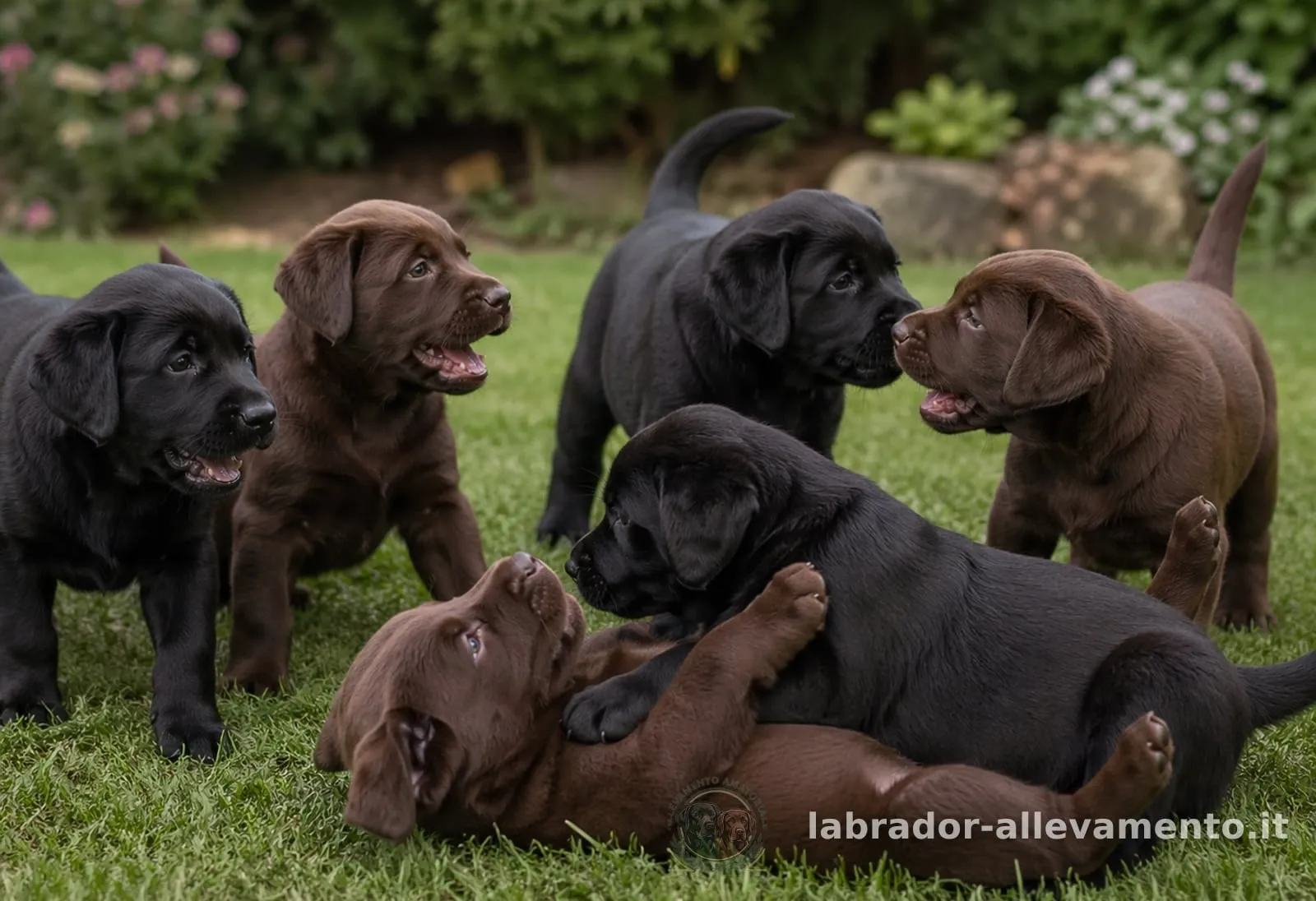
We have been breeding for 10 years in Comabbio, in the province of Varese, between Lake Monate and Lake Varese. The puppies are born in a whelping room fitted out specially for them and grow up in the garden, where the adult dogs spend the day running free. We are 45 minutes from Milan, 30 from Como, 20 from the border with Canton Ticino and a quarter of an hour from Malpensa airport.
- Since
- 2016
- Breeding dogs
- 5
- Litters/year
- 1–2
- Breeder
- Small-scale
The word
“Hobby breeder” doesn't mean amateurish
It's the question Italian families ask us most, and we understand why: the Italian word, amatoriale, sounds like “beginner”. In fact it isn't a judgement on anyone's skill: it is a tax category laid down by Italian law.
The Italian law on dog breeding refers to a decree from 1994, which draws the line with two numbers and nothing else:
“Breeders who keep fewer than five breeding females and who produce fewer than thirty puppies a year are not agricultural entrepreneurs.”
Below those numbers you are a hobby breeder; above them, a professional one. We have one or two litters a year: well below the threshold, and not by chance.
What actually differs between the two categories
| Hobby | Professional | |
|---|---|---|
| Italian VAT number and Chamber of Commerce registration | not required | compulsory |
| Number of breeding females | fewer than 5 | 5 or more |
| Puppies per year | fewer than 30 | 30 or more |
| ENCI/FCI pedigree | same | same |
| Microchip and dog registry | same | same |
| Health and traceability obligations | same | same |
| ENCI breeding rules | same | same |
The rows in green are the ones that concern the puppy you take home, and they are identical. Article 3 of the same law requires anyone who breeds dogs “in any capacity” to follow regional regulations and the ENCI (Italian Kennel Club) rules on breeding: there are no double standards here.
What changes is the scale. A professional kennel has to produce enough to support itself; we don't, and we can afford to skip a mating if a female isn't ready. Neither is wrong: they are two different trades that go by the same name.
Our approach
What we have chosen not to do
A kennel can be run like a production business: more breeding females, more litters a year, dogs housed in sheds that are efficient to clean. It's legal, it's profitable, and it's why short waiting lists and constant availability exist.
We have remained a small-scale hobby breeder, and love of the breed is the only reason we do this. What follows isn't a set of slogans: these are limits we've set ourselves, and they cost us litters.
- 01
Their own kennels and open space, no industrial sheds
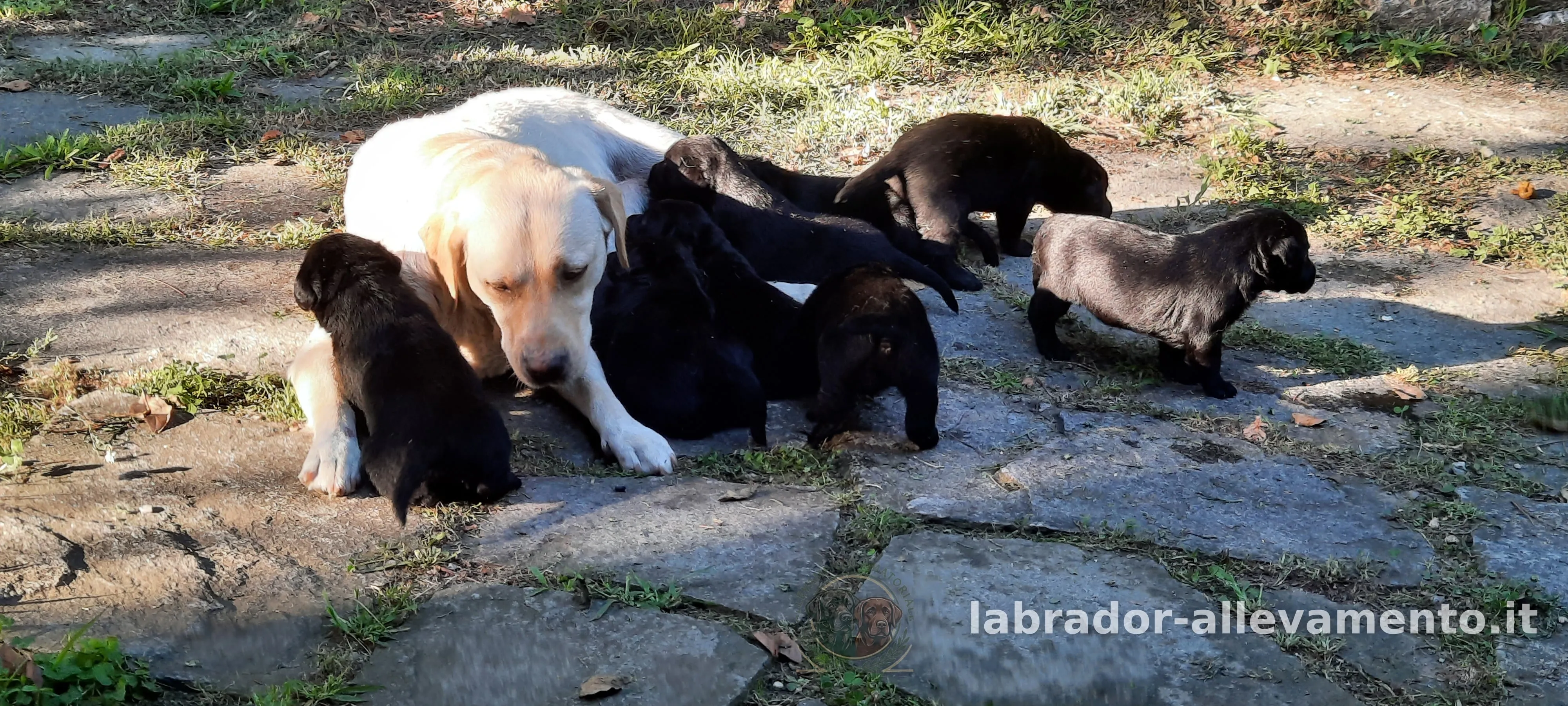
The difference isn't whether there is a kennel or not: it's what it's like and how much time is spent in it. Our adults spend the day free in large enclosures and green spaces, in contact with us; at night and at mealtimes each has its own covered, dry and sheltered resting area. The kennel is for sleeping, eating in peace and managing seasons safely — not for keeping a dog shut in around the clock. It is the opposite of the sheds and stacked cages of intensive breeding, where a dog can spend its whole life without seeing a lawn.
- 02
Respecting natural cycles
Our dams have no more than one litter a year and are retired from breeding well before the permitted limit, staying with us for the rest of their lives. We skip a season whenever it's needed. That means fewer litters and longer waiting lists: a consequence we accept, not a problem to get round.
- 03
Temperament first
We select dogs that are structurally correct according to the breed standard, but the first thing we look at is the head. A Labrador must be well balanced: no nervousness, no shyness, no reactivity. A beautiful dog with a fragile temperament doesn't enter our breeding programme, however much it might win in the show ring.
Our protocol
The first sixty days, day by day
Dogs have a socialisation window that opens around the third week and closes towards the twelfth. Whatever a puppy meets during that period it files away as normal; whatever it doesn't meet may remain frightening for the rest of its life. It's a window that never reopens — and it lies entirely in the breeder's hands.
- Days 0–14
The nest and early stimulation
The puppies are born in the whelping room: a dedicated nursery pen, heated and kept at a controlled temperature, quiet, with easy-to-sanitise surfaces and pig rails. At this stage they are deaf and blind and the work is all the mother’s: we keep constant watch, apply the early neurological stimulation protocol — very brief, controlled handling exercises that act on the autonomic nervous system — and weigh every puppy every day.
- Days 15–21
Eyes and ears open
Sight and hearing arrive. We introduce the first sounds at low volume and the first surface other than the nest blanket. Human contact becomes daily and prolonged: they pass through the hands of the whole family, children included.
- Days 22–35
The pen opens onto the house
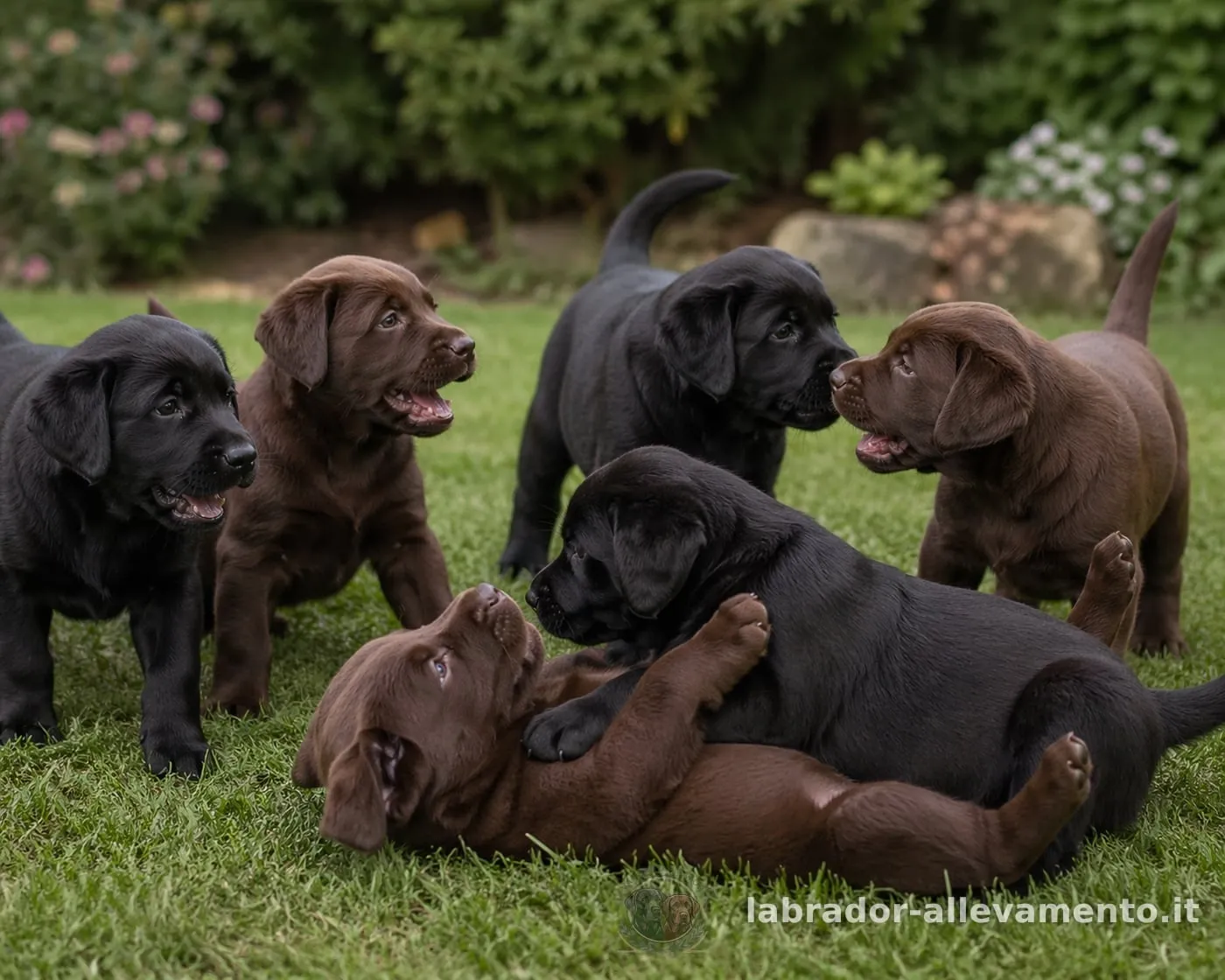
The nursery opens onto the adjoining area and then onto the garden: the puppies start exploring. Grass, gravel, wood, tiles, a wobbly walkway. The vacuum cleaner, the doorbell, voices, recorded traffic, the sounds of everyday life. Every stimulus is introduced gradually and always with the mother present.
- Days 36–49
The pack and people
The kennel’s adult dogs come on stage, teaching self-control and bite inhibition better than any human exercise. Trips into the garden begin, along with visits from people outside the family and a first encounter with the car. First vet check, microchip, vaccination.
- Days 50–60+
Ready to move house
Lead, travel crate, short car journeys, gradual separations from the litter so they get used to being alone for a few minutes without panicking. At this point we look at the temperament that has emerged and suggest the match with a family. Puppies never leave before 60 days.
Always a gentle method
Positive reinforcement and no coercion, both at the kennel and in the advice we give after the puppy goes home. A puppy learns because it pays off, not because it's afraid: the second way may work faster, but it does damage you pay for over years.
Our growth guide (in Italian)
Selection
Health transparency: documents, not words
“Health-checked parents” means nothing on its own. A health check exists if it has a report, a date, the body that issued it and a number that identifies it. Everything below can be seen in the original during your visit, and as a digital copy on request before you commit to anything.
- HD · ED
Dysplasia: a voluntary check
The official scoring of hips and elbows is not required to breed a litter and register it: it is a check a breeder chooses to do. It is carried out from 12 months of age by sending the X-rays to an official scoring centre, such as Ce.Le.Ma.Sche. We had it done on Axila and her hips were graded A, the best on the scale. It has not been done on our other breeding dogs, and their records say so.
- PRA · EIC
Genetic tests for breed-related conditions
Progressive retinal atrophy (prcd-PRA) and exercise-induced collapse (EIC) are the two hereditary conditions of most concern to the Labrador. The status of each breeding dog — tested, clear by parentage or not tested — is published on its record. Our rule is that a carrier is only ever mated with a clear dog.
- DNA
DNA profile on file
The DNA profile of every breeding dog is on file at Vetogene, the laboratory designated by ENCI (the Italian Kennel Club). It is the only compulsory genetic requirement for a breeder, and it is what makes the parentage stated on the pedigree verifiable: the parent–puppy match is not a promise, it is data that a laboratory can check.
Each breeding dog has its own public record with the results in plain sight: hip grade, elbow grade, the result of each genetic test and the date of the latest eye examination.
See the health recordsThe relationship
Before, during and for the whole of your dog's life
A puppy stays with you for twelve, fourteen years. The day it goes home is the start of that time, not the end of our work.
- Before
The introductory conversation
We don't sell sight unseen. Before any reservation we sit down and talk: how many hours the dog will be left alone, how much space you have, whether there are young children or other animals, how much experience you have with the breed. If it turns out that a Labrador isn't the right dog for you, we will tell you — it has happened and it will happen again.
- During
Visits by appointment
You can come and see the puppies from 30 days of age, one family at a time and always by appointment. You can look but not touch: until they are vaccinated the puppies' only protection comes from their mother. It isn't rudeness: in the first weeks, coming and going adds to the mother's stress and the health risk. We also ask that you haven't visited other kennels or dog shelters in the previous 24 hours.
- After
SOELI Care, for life
The relationship doesn't end when the puppy goes home. We are reachable on WhatsApp for the first night, for the soft stools in week three, for the doubt about weight at six months and for the question that will come eight years from now. We know your dog's bloodline because we raised it: an advantage no call centre can offer.
SOELI Care
Over time our after-care has grown into a proper programme: a feeding plan tailored to your puppy’s actual weight, and the ration adjusted during the months of growth. Your puppy goes home eating the same food it has eaten here, so nothing changes all at once.

The person behind it
Enrico Lanfossi
When you get a reply to a message, it's me on the other end. Not an assistant, not an automated system: the person who was there when that litter was born and who weighed that puppy every day for two months.
It all began in 2015 with Maggie: a three-month-old blonde puppy, a birthday present for my daughter Elisa. With her in the house we found out what living with a Labrador really means, and that passion ended up taking over all our lives — mine, Elisa’s and her sister Sofia’s.
The kennel's name comes from the two of them: SO from Sofia, ELI from Elisa. Since 2016 we have been breeding Labradors in all three colours — black, yellow and chocolate — deliberately keeping the number of dogs small. In 10 years the kennel itself hasn't grown much: what has grown is the health testing, the paperwork and the time I spend on the phone with families after their puppy has gone home.
If I tell you a puppy isn't right for you, I'm not losing a sale: I'm making sure that dog doesn't end up in a shelter two years from now.
Writing works better than phoning: I reply in English with the help of a translator, so write as you normally would.
Come and meet us
An afternoon in Comabbio, the dogs free in the garden and all the questions you like. No obligation: it is first of all for you, to work out whether a Labrador really is the right dog for you.
Comabbio (VA) · 45 minutes from Milan, 20 from the Swiss border.